
Organizational Development Consulting
Where Career Authorship™ Meets Identity-First Talent Strategy
Building the talent development infrastructure, programming, and human-centered strategy for the organizations ready to close the divide between what they expect from their people and what their people actually experience.
The talent development reality

Addressing the divide between what organizations expect from their people and what those people actually experience.
The Expectation-Experience Divide, the gap between what organizations expect from their people and what they actually experience, shows up in engagement surveys that plateau despite real investment, in exit interviews where high performers cite lack of growth, and in AI adoption initiatives that generate anxiety instead of momentum. Most organizations call it a retention or engagement problem and respond with another program, platform, or initiative. The investment is there, but the results don't follow.
The reason is structural. Most talent development addresses skills, promotion readiness, and competency frameworks without ever reaching the foundational layer that actually drives engagement, retention, and performance.
That layer is identity. Who is this person professionally? What are their strengths, their values, what do they want their career to look like? Without this foundation, development is tactical at best and performative at worst. This is the divide Kelly Nash & Co. was built to close.
You cannot build a talent development program or initiative that produces lasting results without first building the infrastructure that addresses the identity layer underneath it.
The philosophy behind the work
Identity first. Strategy second.


The workforce landscape is shifting in real-time. The organizations keeping pace and growing their people aren't just adding more programs to the stack. They're building the foundation that makes their people adaptable, regardless of what the landscape does next.
Career Authorship™ is the philosophy and framework that addresses the identity layer first. When employees understand who they are and what value they bring, the skills, positioning, and strategy that follow actually hold. When this is done in this order, engagement becomes genuine, internal mobility becomes real, and AI adoption happens with confidence rather than fear.
Read the full point of view → The Beliefs Behind the Work
What makes this approach different
This framework was built, tested, and scaled within an enterprise organization.
Consultants approach talent development from the organizational level and career coaches work with individuals on career clarity and transition. Kelly Nash & Co. operates at the intersection of both. When you understand what high-achieving professionals are actually experiencing inside their careers, you build organizational programs differently. You design for the employee in front of you, not the one you assumed is there.
I previously architected the employee experience and talent development function for Salesforce's Customer Success organization. This business unit of 9,000 employees navigated AI disruption, organizational restructuring, and the same workforce pressures most organizations are facing today. I saw a gap and proactively built identity-first career development infrastructure from the ground up and measured what happened.
When Salesforce chose redeployment over reduction for its Support Engineering population in 2025, I owned that transition work at the human level. As a result, hiring managers across the organization called the redeployed engineers some of the best hires they had ever made.
That is what happens when organizations invest in helping people understand their own value before they walk into a new room.
By the numbers
+8 points
Career development sentiment above company baseline, validated through Salesforce's Global Intelligence System
10%
Improvement in overall employee engagement scores, sustained over multiple quarters
3,300+
Employees reached through the Career Development Learning Series, with 79% rating it 5/5
9,000+
Employee organization at Salesforce where the Career Authorship™ Framework was built and scaled.
How the identity-first infrastructure gets built
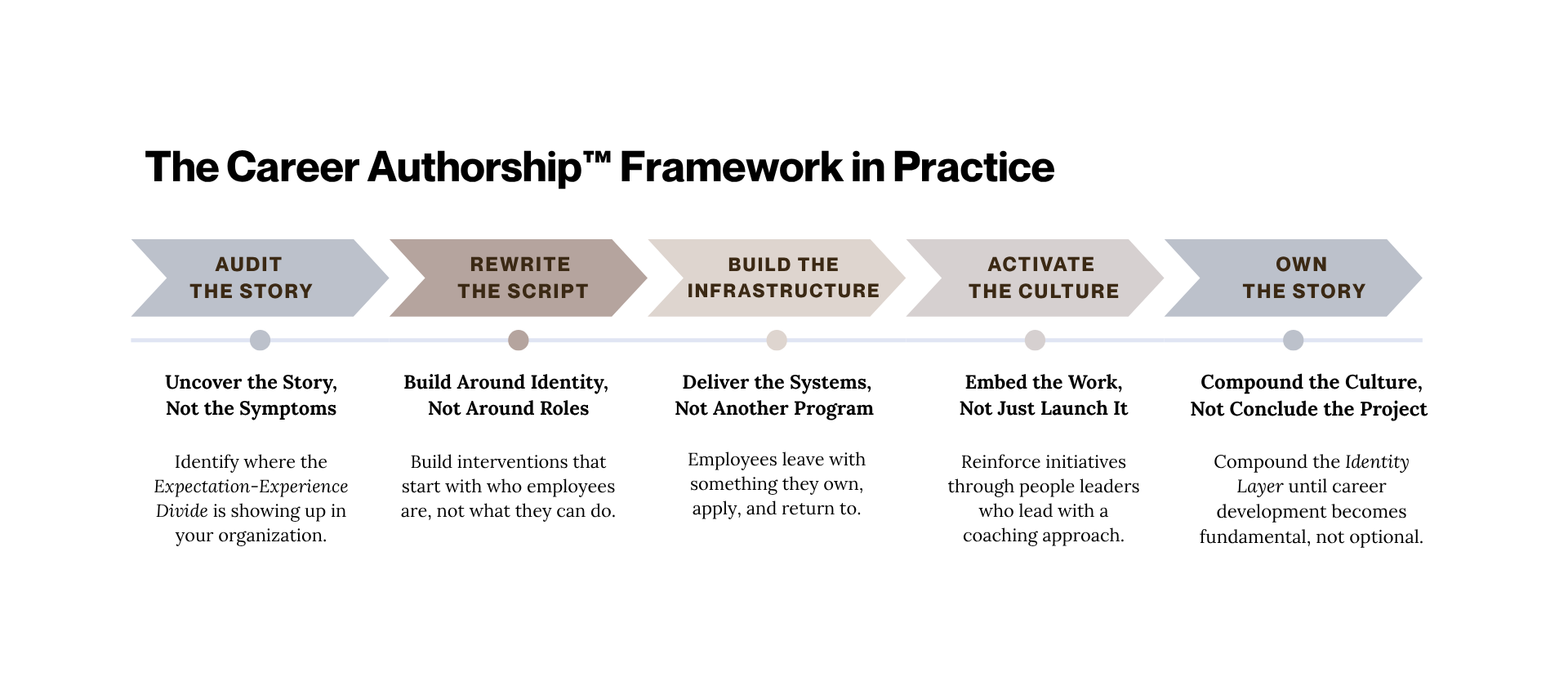
Most talent development starts with the skills employees need to build and works outward from there. This approach inverts that, starting with who employees are and building the infrastructure around them. It is the same methodology whether the engagement is a single workshop or a multi-year embedded partnership. What changes is the depth.
This is what it means to build talent development around the human — not around the role and not around the skill, but around the person doing the work.
Where the philosophy becomes practice
Where organizations start

Every engagement begins with an alignment conversation — a direct discussion about your current challenges, goals, and desired outcomes. There is no single right path. There is only the right starting point for where your organization actually is.

The Spark
Speaking & Workshops
An entry point for organizations that want to experience the Career Authorship™ philosophy before committing to a larger engagement, through keynotes and facilitated workshops designed for leadership teams, employee audiences, or HR and L&D functions.

The Build
Defined Consulting Engagements
A scoped engagement with a clear timeline and deliverable set. This is where the identity infrastructure gets constructed based on what your organization actually needs. Every Build engagement produces something your organization owns and sustains long after the engagement ends.
-
Signature offerings:
→ The Career Authorship Program A cohort-based program that moves employees through four phases — Clarity, Brand, Communication, and Activation — with AI integrated throughout as a personal career development tool, not a productivity shortcut. Each phase produces a tangible output employees own and use independently.
→ Group Coaching for Leaders Cohort-based group coaching for people leaders navigating the intersection of their own career development and their responsibility to develop others.
Best for: Organizations ready to build identity-level infrastructure and invest in lasting results.

The Partner
Fractional Ongoing Engagement
A fractional ongoing partnership for organizations navigating sustained workforce transformation — restructuring, AI integration, culture change, or the ongoing work of building a career development culture that compounds over time.
-
Every Partner engagement begins with the Workforce Culture Audit — a structured diagnostic that identifies where the Expectation-Experience Divide is showing up most acutely before anything is built or deployed.
The Partner stays embedded through implementation, iteration, and the moments where you need a strategic thought partner, not just a deliverable.
A monthly bank of spot coaching hours is included — available to leaders and employees at the inflection points programs cannot reach.
Best for: Organizations navigating sustained transformation who need more than a program.

Strategic Advisory
On-Demand Consultation & Support
Focused strategic guidance and support on a specific talent development challenge, without the scope of a full engagement.
-
Strategic advisory services are offered in 3-hour blocks at $400/hour.
Every engagement is built around a coaching perspective that changes what the work produces at every level, in how the initial alignment conversation is conducted, how people leaders are developed, and how the work stays present through implementation rather than ending at delivery.
This is not a consulting practice that drops a program and leaves. It stays embedded through the moments that matter.
Eager to close the divide?
If you recognize the Expectation-Experience Divide in your organization and you're ready to explore what identity-first talent development could look like in practice, the next step is a conversation. Let’s discuss what's happening and whether this work is the right fit.